Cost vs. Value Guide — Joplin, MO
Are Epoxy Garage Floors Actually Worth It?
Last updated: August 2026
A straight answer on whether a professionally installed epoxy floor pays for itself — in day-to-day use, in what it saves you over bare concrete, and in what it does (and doesn’t) do for resale.
In This Guide
The Short Version
Yes — If It’s Installed Right
For most homeowners, a professionally installed epoxy garage floor is worth it. It costs more upfront than a DIY paint kit or leaving concrete bare, but it also lasts 10–20x longer than either, so the real per-year cost usually comes out lower — not higher.
Where it stops being worth it: a rushed, under-prepped install from a low-bid contractor. Skipped grinding and untested moisture are the two things that turn a 15–20 year floor into a peeling mess in year two. The value math only works when the install is done properly — which is really a question of who you hire, not whether epoxy itself is a good idea.
The Real Numbers
What You’d Actually Spend Over 15 Years
Click an option to see how it holds up — and what it costs — over time.
$0 Upfront — Costs You in Other Ways
No install cost, but bare concrete dusts constantly, stains permanently, and cracks over time from freeze-thaw cycling. Most homeowners eventually pay to seal, patch, or coat it anyway — just later, and often after damage has already set in.
Realistic 15-year cost: sealer reapplication every 2–3 years, plus crack repair.
For exact 2026 pricing by system and space, see our full cost guide with an interactive estimator.
Where the Money Goes
What You’re Actually Paying For
Diamond Grinding & Testing
The single biggest cost driver, and the step DIY kits and cut-rate contractors skip. It’s also the difference between a floor that bonds for 20 years and one that lifts in two.
Commercial-Grade Material
Multi-part systems built for hot tires, chemicals, and constant traffic — not the single-part formula sold in a hardware store kit.
Trained Labor
Correct mix ratios, working time, and application technique matter as much as the material itself — this isn’t a forgiving DIY process.
A Written Warranty
Something to point to if anything does go wrong — a guarantee a DIY kit or an unlicensed installer can’t offer.
Beyond the Sticker Price
Does It Actually Add Resale Value?
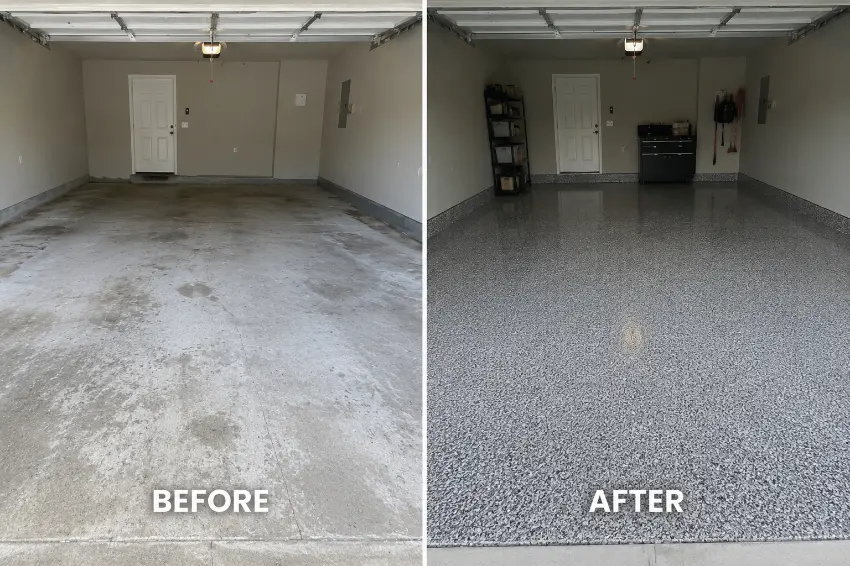
Epoxy rarely shows up as its own line item on an appraisal, but it consistently shows up in how buyers react walking through a garage. A clean, glossy floor reads as “well maintained house” the same way fresh paint or new carpet does — it’s a perception lift more than a hard dollar figure.
The bigger value is functional, not cosmetic: a garage that’s actually usable as a workspace, gym, or extra living area — not just storage on top of dusty concrete. That’s value you get every day you own the house, whether or not you ever sell it.
-
Makes a “storage garage” feel like usable space
The most common reason homeowners say they’d do it again — it changes how the room actually gets used.
-
Protects the slab underneath
A sealed surface blocks the moisture and oil that slowly damage bare concrete — cheaper than a future concrete repair.
-
First impression during a home sale
Buyers notice a clean garage floor even if it’s not on their checklist — it reads as low-maintenance, well cared-for.
Your Situation
Is It Worth It For Your Garage?
Probably Worth It If…
- You use the garage daily — parking, workshop, or gym
- Your concrete already shows dusting, staining, or cracks
- You plan to stay in the home 5+ years
- You’ve priced out repeated DIY redo costs already
Worth Waiting On If…
- You’re selling within the next few months and need to prioritize spend
- Your slab has structural cracking that needs repair first
- You suspect a moisture issue that hasn’t been tested yet
Worth-It FAQ
Value Questions We Get Asked Most
Still weighing it? A free on-site visit gives you real numbers for your specific space.
Get a Free Estimate- Sealer is cheaper but needs reapplying every 2–3 years and offers far less protection against stains, hot tires, and abrasion. Over a 15-year window, most homeowners spend more on repeated sealer than they would have on one epoxy install.
- It’s rarely a standalone appraisal line item, but it consistently improves buyer perception of a garage — similar to fresh paint. The bigger value is functional: it makes the space usable as a workshop, gym, or extra room, which most homeowners value even if they never sell.
- Most DIY kits use thin, single-part epoxy without the grinding and moisture testing a professional install includes — that’s why they commonly start peeling within 1–3 years. It often ends up costing more in repeated redos than doing it professionally once.
- Compared to repeated DIY redo cycles or sealer reapplication, most homeowners break even within 5–8 years, then get another 7–12+ years of use beyond that at no added cost.
- A poor install — skipped grinding, an acid-etch-only prep, or no moisture testing. That’s what causes early peeling and turns a 15–20 year floor into a redo within a couple of years. The value math depends entirely on hiring someone who does the prep work right.
Free Estimates
See What It’s Worth
For Your Garage
A free on-site visit gets you real pricing and a straight answer — no pressure, no obligation.
Get My Free Estimate