Local & Seasonal Guide — Joplin, MO
Why Joplin Winters Are Hard on Bare Concrete
Last updated: July 2026
Southwest Missouri’s freeze-thaw swings do more damage to unprotected concrete than a climate that just stays frozen all winter. Here’s the actual mechanism, what it looks like, and how a sealed surface stops it.
In This Guide
The Actual Mechanism
Water Expands 9% When It Freezes
Concrete is porous. Water works its way into those pores through rain, snowmelt, and groundwater, and when temperatures drop below freezing, that water expands by roughly 9% as it turns to ice. Trapped inside a rigid material with nowhere to go, that expansion pushes outward against the concrete from the inside — creating microscopic cracks that widen with every cycle.
Joplin’s climate is actually harder on concrete than a consistently frozen one further north. A slab that stays frozen solid for months only goes through the freeze-thaw cycle once or twice a winter. Southwest Missouri’s swings — freezing overnight, thawing in the afternoon sun, refreezing again — can put a slab through dozens of these cycles in a single season, each one compounding the damage from the last.
What to Look For
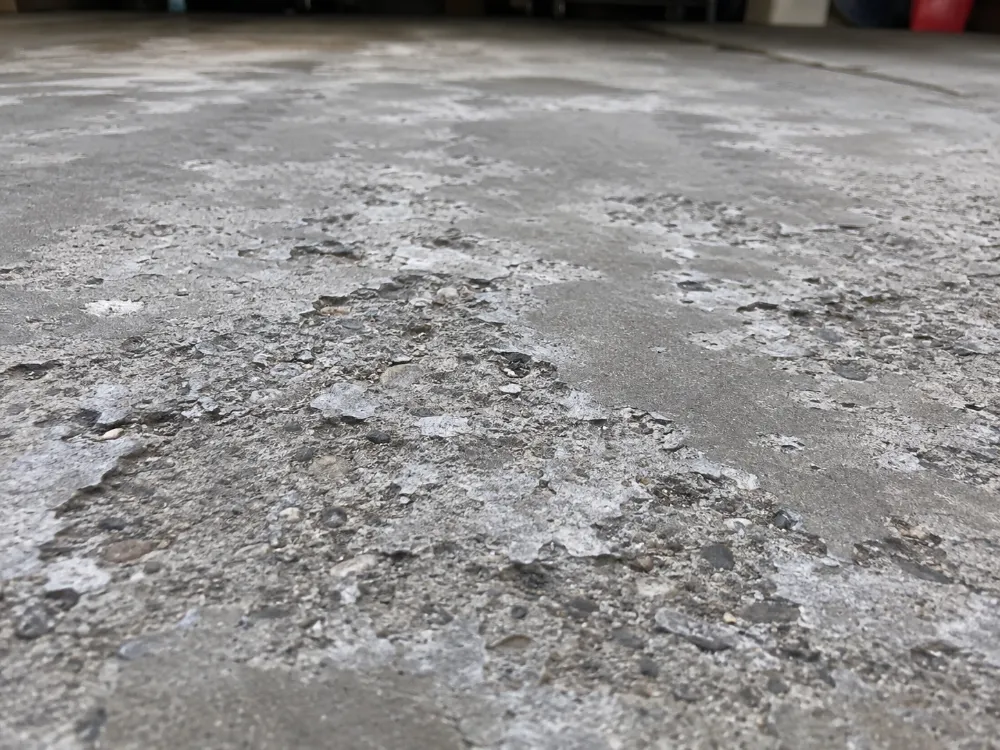
Three Signs Your Slab Is Already Affected
Surface Scaling
A thin top layer of concrete flakes or peels away, exposing the aggregate underneath. Usually the first visible sign, often mistaken for normal wear rather than freeze-thaw damage.
Spiderweb Cracking
Fine, branching cracks across the surface rather than one clean line — a signature pattern of repeated internal expansion rather than a single structural crack.
Pitting & Pop-Outs
Small cone-shaped craters where a piece of aggregate near the surface has popped loose — a later-stage sign that the damage has been building for more than one season.
All three of these show up most on outdoor patios and unheated garage floors — the two spaces that see the most direct exposure to freeze-thaw swings. A heated, finished basement slab is far less exposed to this specific damage mechanism, though it still benefits from a sealed surface for the moisture reasons covered in our moisture guide.
The Actual Fix
A Sealed Surface Gives Water Nowhere to Get In
Freeze-thaw damage needs one thing to get started: water inside the concrete’s pores. A properly installed epoxy system seals that surface completely, so there’s nothing for the winter freeze-thaw cycle to act on in the first place — the damage mechanism never gets a foothold.
Get My Free Estimate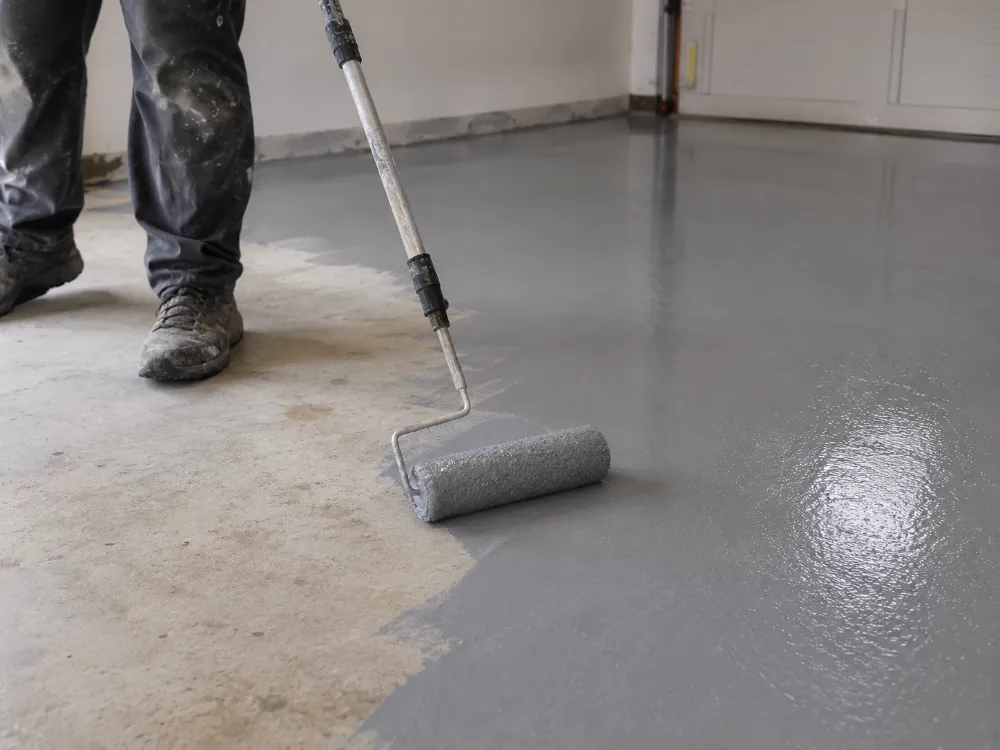
This is the same underlying principle as the moisture vapor protection covered in our peeling and moisture guide — different failure mode, same root cause. Keep water out of the pores, and both moisture vapor problems and freeze-thaw cracking stop being a threat to the slab underneath.
A Second Winter Threat
Salt & De-Icers Accelerate Everything
Rock salt and chemical de-icers lower the freezing point of water on the surface, which sounds helpful but actually increases the number of freeze-thaw cycles a slab goes through in a given cold snap — more melting and refreezing, more cycles, faster scaling. Some de-icers also react chemically with the concrete’s surface, accelerating deterioration beyond the freeze-thaw effect alone.
On a bare garage floor, this shows up as scaling right where salt-covered tires and boots track in. A sealed epoxy surface isn’t affected the same way — salt and de-icer residue just sits on top and wipes or rinses off, since there’s no exposed porous concrete underneath for it to react with.
Timing It Right
Best Time of Year to Install in SW Missouri
Ideal Window: Late Spring Through Early Fall
Epoxy needs a stable temperature (generally above 50°F) and low humidity to cure properly. April through October gives the most reliable stretch of installable days for garages and especially for outdoor patios that need direct temperature control during cure.
Winter Installs Are Still Possible
Indoor spaces like garages and basements can often be coated year-round if the space can be temporarily heated to maintain cure temperature. Outdoor patio work is more weather-dependent and gets scheduled around forecast windows.
If your slab is already showing scaling or cracking from a past winter, waiting for the ideal season isn’t required to get a quote — we’ll assess the damage and tell you honestly whether it’s better to coat now or wait for warmer, more controllable conditions. For the full season-by-season breakdown, including how indoor and outdoor timing differ, see our complete install-timing guide.
Winter FAQ
Questions About Winter Damage
Not sure if your slab’s damage is freeze-thaw related? Ask during your free estimate.
Get a Free Estimate- It genuinely stops it going forward, since the damage requires water getting into the concrete’s pores and a properly sealed coating blocks that. It won’t reverse damage that already happened, but it prevents new cycles from making it worse.
- Yes, in most cases. Cracks get routed and filled during prep the same way any other crack repair is handled, then the coating goes over a structurally sound, sealed surface. Severe structural damage would need a concrete contractor’s input first.
- Much less so — a consistently heated space rarely sees the slab itself drop below freezing, which removes the freeze-thaw mechanism almost entirely. Unheated garages and outdoor spaces are where this matters most.
- No need — estimates and moisture testing can happen any time of year. It’s only the actual coating application that’s more weather-dependent, and we’ll help you find the right window during your visit.
Free Estimates
Protect Your Slab
Before Next Winter
A sealed surface is the single best defense against freeze-thaw damage in Southwest Missouri.
Get My Free Estimate